[FR]
Parties
Les Parties reconnaissent le besoin
Les Parties désirent
Mais qu’ont-elles convenu exactement ? Et pour qui ?
Les Parties affirment – mais que reste-t-il de ce sur quoi les Parties se sont accordées, il y a trente ans, lorsqu’elles signèrent les accords de Dayton-Paris ?
Conclus le 21 novembre 1995 à l’issue de vingt et un jours de négociations menées sur la base militaire de Dayton (Ohio, États-Unis), sous les yeux de la presse et des dirigeants du monde entier, les accords furent officiellement signés par les dirigeants bosniaque, croate et serbe le 14 décembre 1995 au palais de l’Élysée, à Paris.
Écrits pour mettre un terme à la guerre qui détruisait la Bosnie-Herzégovine depuis plus de trois ans, les accords de Dayton-Paris servent aujourd’hui encore de constitution au pays, une structure impénétrable qui en gouverne toujours le destin. Sans perspective d’évolution proche, le pays semble enfermé dans cet état de permanente impermanence, comme suspendu dans l’instabilité même.
Les Parties se conformeront ; les Parties respecteront ;
Depuis plusieurs années, une partie du travail de Bojan Stojčić s’intéresse à ces accords comme symbole de cette réalité figée de la Bosnie-Herzégovine, en interrogeant ses symboles – matériels, monumentaux, linguistiques – et leurs sens dans le présent, liant sa propre réalité sensible à la marche de l’histoire.
Il poursuit cette enquête dans l’exposition Bureau Fantôme (Institut d’études slaves, Paris, 19 mars – 30 avril 2026) pour laquelle il part à la quête du texte même des accords.
Le film Hope Hotel Phantom (2023), présenté dans l’exposition, constitue une première tentative pour comprendre, à partir de l’expérience propre de l’artiste, la racine de ce texte. Le film documente son séjour en Ohio, au Hope Hotel – où furent négociés les accords. Parti seul, l’artiste s’y retrouva plus radicalement isolé encore qu’il ne l’avait anticipé : l’hôtel n’accueille aucun autre client que lui pendant la semaine qu’il y passe. Il y erre entre les salles de conférence vides de conférenciers, documente ses rêves, échange avec le personnel – à la quête de la moindre trace de ce texte fondateur dont le lieu ne semble avoir gardé mémoire.
Mais cette première exposition parisienne de l’artiste naît aussi d’un fait singulier : signées à Paris, les versions originales de l’accord furent consignées aux parties signataires. Or, en 2009, la Bosnie-Herzégovine annonçait la perte de son seul exemplaire des Accords — la seule trace tangible de ce monument de papier.
Le pays dut alors demander à la France l’envoi d’un fac-similé du texte original, conservé aux archives du ministère des Affaires étrangères — et se retrouvait, dès lors, doté d’une constitution Fantôme.
Impossible de se souvenir de ce que Les Parties respecteront intégralement, quand le texte même s’échappe.
C’est peut-être de cette impossibilité du dire que tentent de parler les langues de céramique de la série Tongues (2026) exposées, comme autant d’artefacts biologiques, sous des vitrines de verre. Percées de métal, elles semblent s’agiter pour nous communiquer un message qui ne parviendra jamais à nos oreilles — et quelle en serait la langue ?
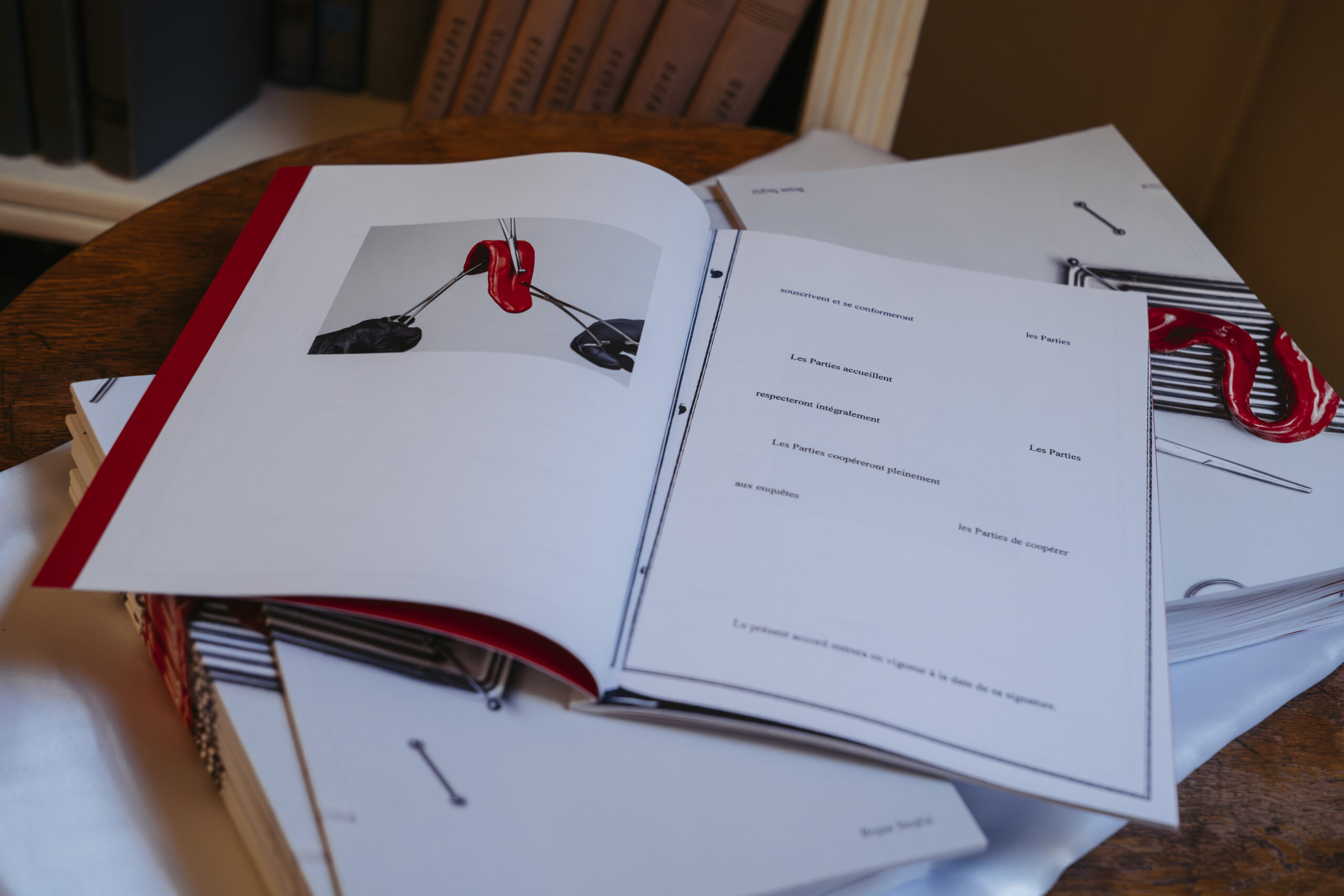
C’est aussi à ce silence imposé, à ce texte spectral, que fait référence la publication Parties – Strane, qui accompagne l’exposition sous la forme d’un essai poétique et photographique, basé sur le document original des accords de Dayton-Paris. Mais qu’a-t-il à nous dire ?
les Parties
souscrivent et se conformeront
Melody Robine
.
[ENG]
The parties recognize the need
The parties desire
But what, exactly, have they agreed to? And for whom?
The parties affirm — but what remains of what the parties agreed upon thirty years ago, when they signed the Dayton-Paris Agreements?
Concluded on 21 November 1995 after twenty-one days of negotiations conducted at the Dayton military base in Ohio, United States, under the eyes of the press and of political leaders from around the world, the Agreements were officially signed by the Bosnian, Croatian, and Serbian leaders on 14 December 1995 at the Élysée Palace in Paris.
Written to bring an end to the war that had been devastating Bosnia-Herzegovina for more than three years, the Dayton Accords still serve today as the country’s constitution, an impenetrable structure governing the its destiny. With no real prospect of change, the country seems trapped in this state of unstable permanence, as if suspended within instability itself.
The parties shall comply; the parties shall respect;
For several years now, part of Bojan Stojčić’s work has focused on the Dayton-Paris Agreements as a symbol of this frozen reality of Bosnia-Herzegovina, interrogating its material, monumental and linguistic signs, and their meaning in the present ; linking his own sensorial reality to the movement of history.
He continues this investigation in the exhibition Bureau Fantôme (Institut d’études slaves, Paris, 19 March – 30 April 2026), for which he sets out in search of the very text of the Agreement.
The film Hope Hotel Phantom (2023), presented in the exhibition, constitutes an initial attempt to understand, through the artist’s own experience, the root of this text. The film documents his stay in Ohio, at the Hope Hotel, where the Agreements were negotiated. Travelling alone, the artist found himself even more radically isolated than he had anticipated: throughout the week he spent there, the hotel hosted no other guest but him. He wanders through conference rooms empty of conference-goers, records his dreams, speaks with the staff – in search of the slightest trace of this founding text, of which the site itself seems to have retained no memory.
But this first Paris exhibition by the artist also stems from a singular fact: signed in Paris, the original versions of the agreement were deposited with the signatory states. Yet in 2009, Bosnia-Herzegovina announced that it had lost its only copy of the Agreements — the sole tangible trace of this paper monument.
The country therefore had to ask France to send a facsimile of the original text, preserved in the archives of the Ministry of Foreign Affairs, and thus found itself endowed with a phantom constitution.
It is impossible to remember what the parties shall fully respect when the text itself slips away.
Perhaps it is this impossibility of speaking that the ceramic tongues from the series Tongues (2026) attempt to voice, displayed like biological artefacts beneath glass vitrines. Pierced with metal, they seem to stir in order to communicate a message to us that will never reach our ears — and in what language would it be spoken?
It is also to this imposed silence, to this spectral text, that the publication Parties – Strane refers, accompanying the exhibition in the form of a poetic and photographic essay, based on the original Dayton-Paris document. But what does it have to tell us? The parties welcome and endorse
Visual © Basak Dinc – Paris College of Art