Can one walk on these stones? Can one still walk on stones whose history one does not know? And what will happen to us if we take the risk of approaching them?
Some stones are heavy with words, with hopes, with hatred; heavy with the weight of their own history and of the history that will not come to pass. They seem to contemplate us from a space to which access will never be entirely granted. From their high walls, their colours, their carefully assembled volumes, certain monuments, erected to the glory of past glories, seem no longer able to speak to us in the present. They seem destined to keep us at a distance: because we come from another land, another time, another language, or other systems.
This distance has led many observers to see in certain modernist monuments of the post-Yugoslav space only a surface: an abstract, spectacular form, detached from the social, political, and historical realities that brought it into being. It is so easy to look at them negatively, as traces of a future that never came; so easy, too, to turn them into machines of aesthetic fascination, into premature ruins of a supposedly vanished civilisation. Their concrete, their rust, their fading colour then seem to embody the grandeur and misery of a past believed to be closed.
But the political, social, and memorial mechanisms that presided over the construction of these monuments still belong to our world. In the post-Yugoslav space, monuments linked to the Second World War, antifascist resistance, socialism, or national narratives have often been subjected to contradictory readings: formal admiration, political instrumentalisation, nationalist reinterpretation, nostalgia, rejection… But a monument is never only a mass in the city: these forms cannot be understood without questioning, beyond their plastic power, the conditions of their visibility, their memorial function, and the political uses they enable today.
Can I then draw on these stones? Who left their trace there before me? Which one of us wore out their hands and eyes drawing the plans, the walls, each shadow imprinted upon them, without leaving us a name?
It is this capacity to appropriate these forms that the artists gathered here address. Their works do not seek to naïvely re-enchant monuments, nor to reduce them to simple signs of a bygone past. They approach them as forms that are still active, within which questions of memory are bound together with the possibility of a renewed gaze upon this history.
In Clément Bedel’s work, monumental structures first seem to emerge from a familiar landscape, yet they never fully settle within it. Architectural forms lose their frontal authority and become shifting presences, traversed by colour and light. These almost organic forms allow us to imagine their possible transformations, the futures that might grow from forms some imagine to be extinguished. Matter seems at times to dissolve into its environment, at times to struggle against it. The water flowing from Clément Bedel’s canvas raises the question of the fluidity of meaning itself: how do these forms continue to exist in the present?
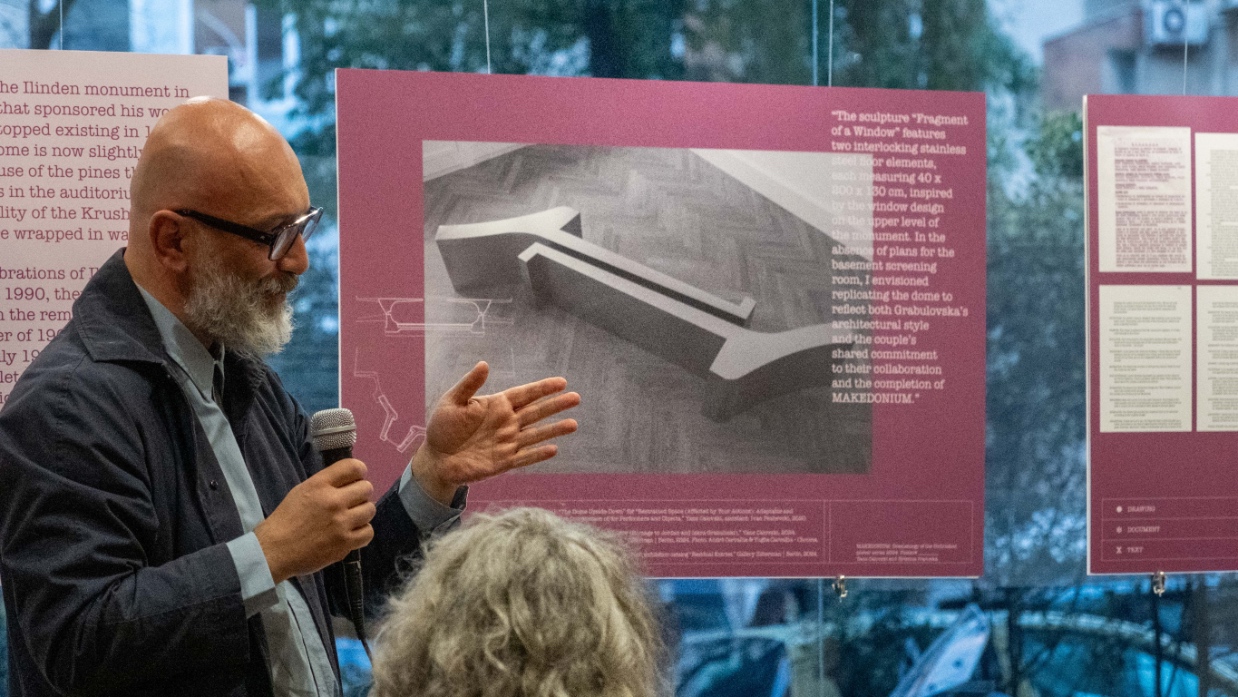
With Makedonium: Dramaturgy of the Unfinished, Hristina Ivanoska and Yane Calovski work from an emblematic monument of the Socialist Republic of Macedonia: the Ilinden Monument, known as the Makedonium, built in Kruševo between 1969 and 1974 by Jordan Grabuloski and Iskra Grabuloska. Their collaborative project invites us to rethink the construction of the monument as a social, political, and historiographical process, whose consequences concern both those who took part in it and the form of the monument itself. By delving into the archives of the monument’s construction, the artists reveal the central role of Iskra Grabuloska, long kept in the shadow of official documents as well as public memory.
Presented together, Clément Bedel’s paintings and the collaborative project by Hristina Ivanoska and Yane Calovski propose two divergent ways of returning to monuments without fixing them in place. Between them, the same question circulates: how can we still walk among these stones without reducing them to silence?