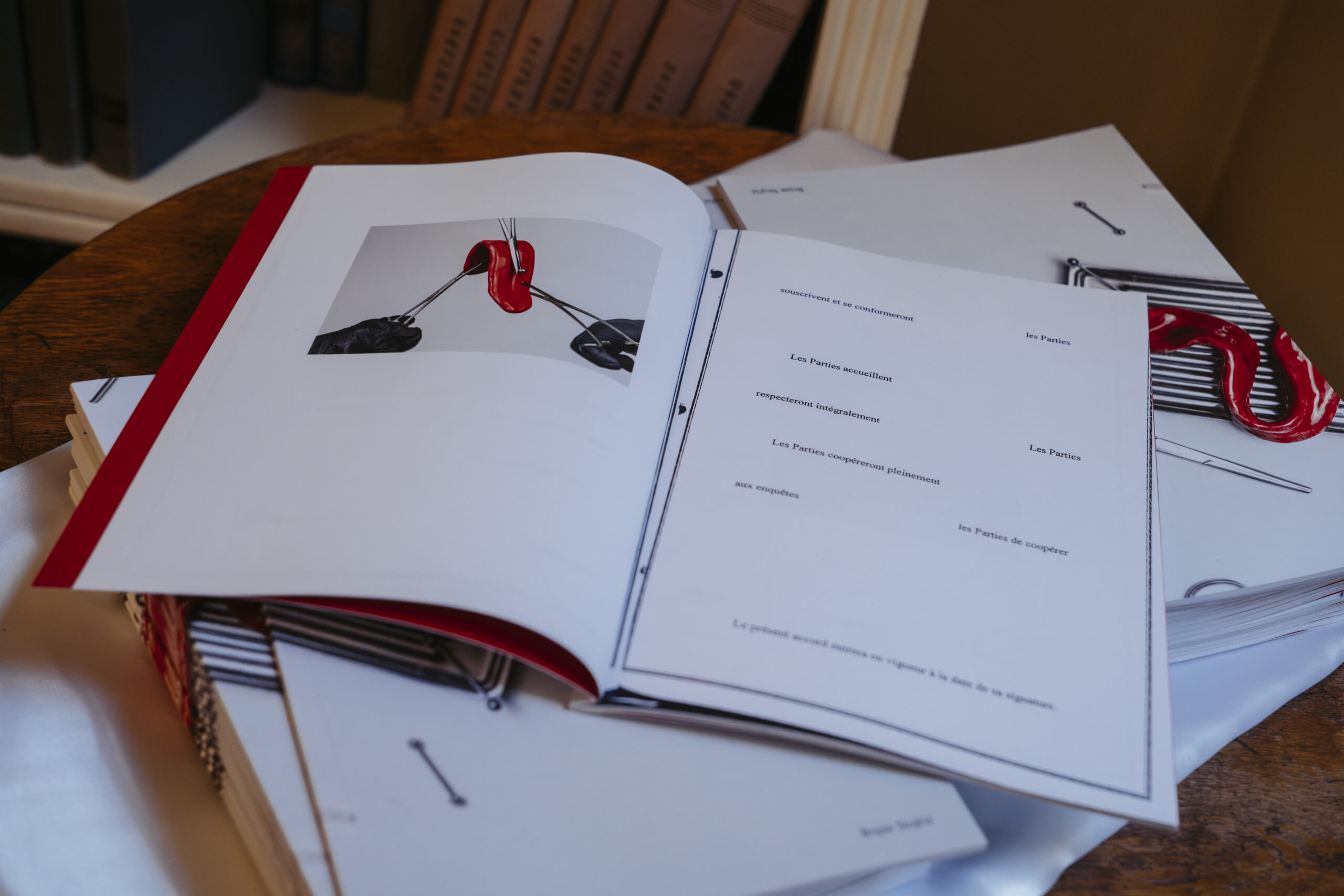
The parties recognize the need
The parties desire
But what, exactly, have they agreed to? And for whom?
The parties affirm — but what remains of what the parties agreed upon thirty years ago, when they signed the Dayton-Paris Agreements?
Concluded on 21 November 1995 after twenty-one days of negotiations conducted at the Dayton military base in Ohio, United States, under the eyes of the press and of political leaders from around the world, the Agreements were officially signed by the Bosnian, Croatian, and Serbian leaders on 14 December 1995 at the Élysée Palace in Paris.
Written to bring an end to the war that had been devastating Bosnia-Herzegovina for more than three years, the Dayton Accords still serve today as the country’s constitution, an impenetrable structure governing the its destiny. With no real prospect of change, the country seems trapped in this state of unstable permanence, as if suspended within instability itself.
The parties shall comply; the parties shall respect;
For several years now, part of Bojan Stojčić’s work has focused on the Dayton-Paris Agreements as a symbol of this frozen reality of Bosnia-Herzegovina, interrogating its material, monumental and linguistic signs, and their meaning in the present ; linking his own sensorial reality to the movement of history.
He continues this investigation in the exhibition Bureau Fantôme (Institut d’études slaves, Paris, 19 March – 30 April 2026), for which he sets out in search of the very text of the Agreement.
The film Hope Hotel Phantom (2023), presented in the exhibition, constitutes an initial attempt to understand, through the artist’s own experience, the root of this text. The film documents his stay in Ohio, at the Hope Hotel, where the Agreements were negotiated. Travelling alone, the artist found himself even more radically isolated than he had anticipated: throughout the week he spent there, the hotel hosted no other guest but him. He wanders through conference rooms empty of conference-goers, records his dreams, speaks with the staff – in search of the slightest trace of this founding text, of which the site itself seems to have retained no memory.
But this first Paris exhibition by the artist also stems from a singular fact: signed in Paris, the original versions of the agreement were deposited with the signatory states. Yet in 2009, Bosnia-Herzegovina announced that it had lost its only copy of the Agreements — the sole tangible trace of this paper monument.
The country therefore had to ask France to send a facsimile of the original text, preserved in the archives of the Ministry of Foreign Affairs, and thus found itself endowed with a phantom constitution.
It is impossible to remember what the parties shall fully respect when the text itself slips away.
Perhaps it is this impossibility of speaking that the ceramic tongues from the series Tongues (2026) attempt to voice, displayed like biological artefacts beneath glass vitrines. Pierced with metal, they seem to stir in order to communicate a message to us that will never reach our ears — and in what language would it be spoken?
It is also to this imposed silence, to this spectral text, that the publication Parties – Strane refers, accompanying the exhibition in the form of a poetic and photographic essay, based on the original Dayton-Paris document. But what does it have to tell us? The parties welcome and endorse
Visual © Basak Dinc – Paris College of Art