Unfolding the City. Art as an Agent of Transformation
Abstract :
This paper explores the intersection of public and participatory art, urban space, and feminist practice through the case of Hristina Ivanoska’s ongoing project Naming the Bridge: Rosa Plaveva and Nakie Bajram. Initiated in 2004, the project addresses the marginalization of women in Skopje’s symbolic and physical landscape¹ and questions the role of contemporary art in redefining the city’s urban environment.
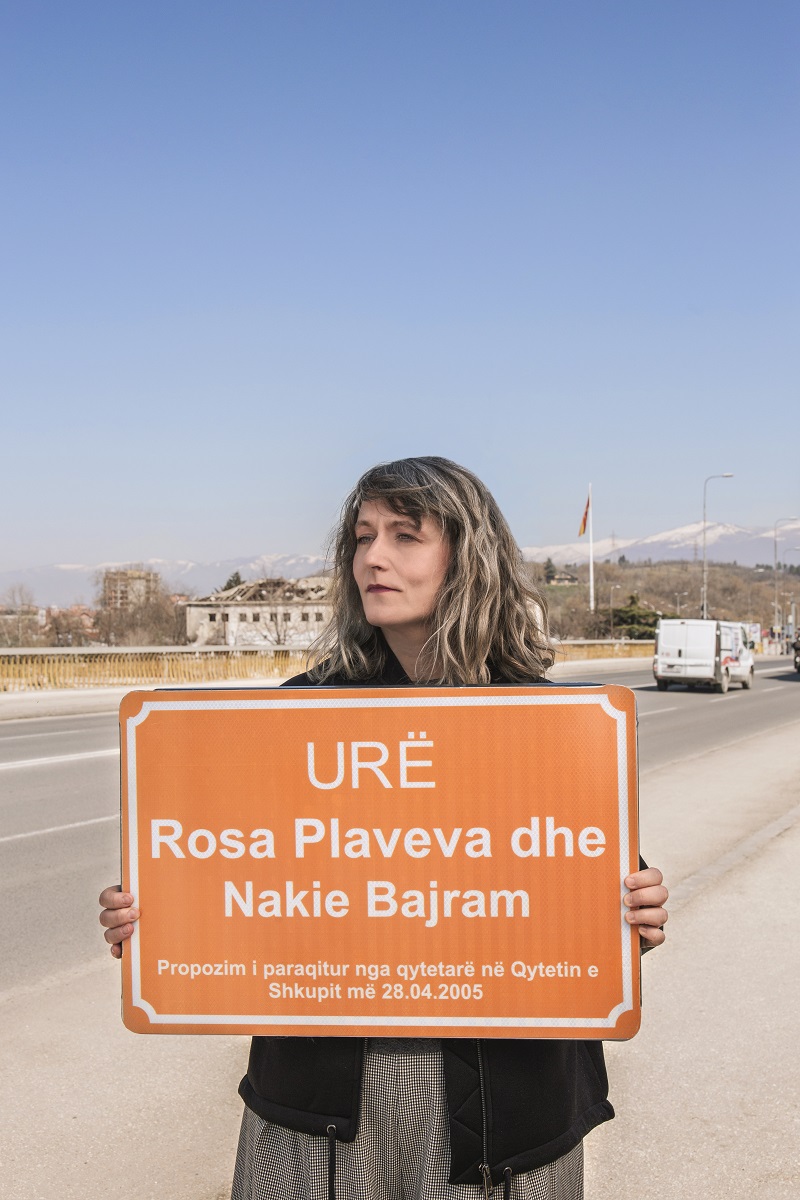
By proposing to name a newly constructed bridge [figure 1] uniting the Muslim and Orthodox parts of the city after Rosa Plaveva and Nakie Bajram — two early advocates of women’s rights and literacy, of Macedonian and Turkish descent respectively — Ivanoska challenges dominant narratives of urban development and the patriarchal logic underlying the naming of public spaces.
In reinvesting these historical figures, Ivanoska engages a complex nexus of memory, identity, and civic participation. Her proposal to the municipal authorities of Skopje to name the new bridge after these two women becomes the basis of a long-term, research-based artistic process that combines historical inquiry, bureaucratic documentation, and performative gesture. Conceived in the aftermath of the 2001 conflict that divided the city and the country along ethnic and religious lines, the project speaks directly to the need for re-establishing a silenced dialogue between communities separated by the river Vardar.
As such, Naming the Bridge offers a telling example of an individual artistic initiative that approaches the question of women’s emancipation with historical sensitivity rather than ideological antagonism. It proposes to build, both metaphorically and materially, a bridge between conflicting cultural and intellectual positions. Through this act, Ivanoska’s work foregrounds the political and emancipatory force of often-dismissed and disavowed twentieth-century histories, in order to confront the rise of nationalism and inter-ethnic conflict in post-socialist North Macedonia and, more broadly, across the former Yugoslav space.
Through this lens, the paper examines how public art can act as an agent of urban transformation — rewriting collective memory, producing alternative narratives, and creating spaces for marginalized voices. Using Naming the Bridge as a case study, it aims to reflect on the complex entanglement between political and cultural processes of renaming and the broader dynamics of identity formation and destabilization in North Macedonia since the fall of Yugoslavia.
It also situates this case within a wider implication of renaming as both a symbolic and political act — one that not only reconfigures visual culture but also reshapes collective and individual subjectivities², specifically in times of political transformation³.
Finally, this paper interrogates the relationship between participatory art and policy-making, particularly in the context of citizen-led initiatives such as Ivanoska’s. Can artists influence urban planning and decision-making processes? What happens when artistic procedures enter the domain of governance? By engaging these questions, the paper contributes to a broader understanding of how feminist art practices not only reshape public space but also intervene in the political, cultural, and historical narratives of the city.
Situating Naming the Bridge within Ivanoska’s broader practice in urban space, this paper argues that the work articulates a form of what I call procedural feminism: a mode of artistic engagement that operates within institutional frameworks to expose their contradictions and to reclaim their capacity for civic meaning.
More on the publication:
Unfolding the City. Art as an Agent of Transformation is the first international conference organized by the Center for the Arts of the Albanian Academy of Sciences. The event addresses the ongoing transformations of the urban image, with particular attention to the profound changes currently reshaping Albanian cities.
More specifically, the conference aims to investigate these processes by examining the impact of contemporary art on the city and on its transformations at social, political, and urban levels. What is the impact of art on the transformation of the city? What tools and methodologies does art employ when engaging with public space? Which spaces can art claim within the contemporary urban condition? In a society increasingly controlled and divided between physical and digital realms, does art in public space still have a meaningful role? And how can interventions in the physical fabric of our ever-changing cities contribute to the creation of new perspectives and alternative approaches to reality?
Visual: Naming the bridge, Hristina Ivanoska, 2004